![CV vs Resume: 10 Key Differences in 2026 [with Examples]](https://cms.hiretip.co/content/images/2025/11/Resume-Vs-CV.webp)
You might feel a little lost in the alphabet soup of job applications. You’re not alone. For decades, job seekers have struggled to distinguish between a CV and a resume, often adding a "Biodata" to the mix for good measure. Is it all just different names for the same document?
Absolutely Not!
In the interconnected global job market, and especially in a diverse hiring landscape like India, using the wrong one can be a costly misstep. It can signal to a recruiter that you're not quite tuned into professional norms. But don't worry! This guide is your friendly navigator. We're going to break down the CV vs Resume vs Biodata confusion with crystal-clear clarity and practical examples, so you can confidently submit the right document every time.
What is a CV? (Curriculum Vitae)
Let's start with the grand, comprehensive one. CV stands for Curriculum Vitae, a Latin phrase meaning "the course of your life." And that's exactly what it is, a detailed, academic-driven chronicle of your professional journey.
Think of your CV as your complete scholarly autobiography. It’s the document of choice when you need to showcase the full depth of your intellectual contributions. You will primarily use a CV in formal, research-oriented contexts like:
- Applying for positions in academia (Professor, Researcher, Lecturer)
- Seeking roles in medical research or as a physician (outside of North America)
- Applying for grants, fellowships, or PhD programs
- Pursuing high-level scientific research positions
A CV is a living document that you continuously add to throughout your career. It has no page limit; a seasoned academic's CV can easily span 10-15 pages.
Common Sections in a CV
A CV is structured to highlight academic prowess. Key sections include:
- Education (often placed first)
- Research Experience
- Publications (Peer-reviewed papers, books, etc.)
- Teaching Experience
- Conference Presentations
- Grants and Fellowships
- Awards and Honors
- Professional Affiliations
- References
What is a Resume?
Now, let's talk about the corporate world's favourite document: the Resume (pronounced "rez-oo-may").
If a CV is a detailed autobiography, a resume is a sharp, compelling marketing pitch. It's a concise, targeted summary of your skills, experiences, and achievements, tailored specifically for one job. Its sole purpose is to convince the hiring manager in under 7 seconds that you are the perfect fit.
The mantra of a resume is relevance, not comprehensiveness. You will use a resume for almost all roles in the private sector, especially in industries like:
- Technology, Business, and Finance
- Marketing, Sales, and HR
- Hospitality and Creative Arts
A resume is typically 1-2 pages long, and you should actively tailor it for each application, highlighting the experiences that align perfectly with the job description.
Key Sections of a Resume
A resume is built for quick scanning and impact:
- Contact Information
- Professional Summary (Your 2-3 line "elevator pitch")- For inspiration, check out these summary examples that actually get recruiters’ attention
- Work Experience (with bullet points focused on achievements and quantifiable results)
- Skills (Technical and soft skills)
- Education
- Certifications (if relevant)
What is Biodata (and How It Differs)
"Biodata" is the term that often causes the most confusion, particularly in the Indian context. Biodata, short for "Biographical Data," is a straightforward, factual record of your personal and professional details.
The core difference between CV and resume and biodata lies in its focus. While CVs and Resumes are achievement-oriented, Biodata is fact-oriented. It lists out information without the fluff or marketing spin.
1.Typical Uses for Bio
- Government Jobs: Many Indian government and public sector application forms are essentially a biodata format.
- Academic Applications: For certain university admissions in India.
- Matrimonial Sites: This is the most common non-professional use, where individuals exchange biodata profiles to facilitate arranged marriages.
2.Typical Biodata Sections
Biodata is often presented in a simple, form-like style:
- Personal Details (Date of Birth, Marital Status, Father's Name, Gender)
- Education (Presented as a simple table with grades)
- Work Experience (Job titles, employers, and dates only)
- Languages Known
- Contact Information
Side-by-Side Comparison: Biodata vs Resume
vs CV
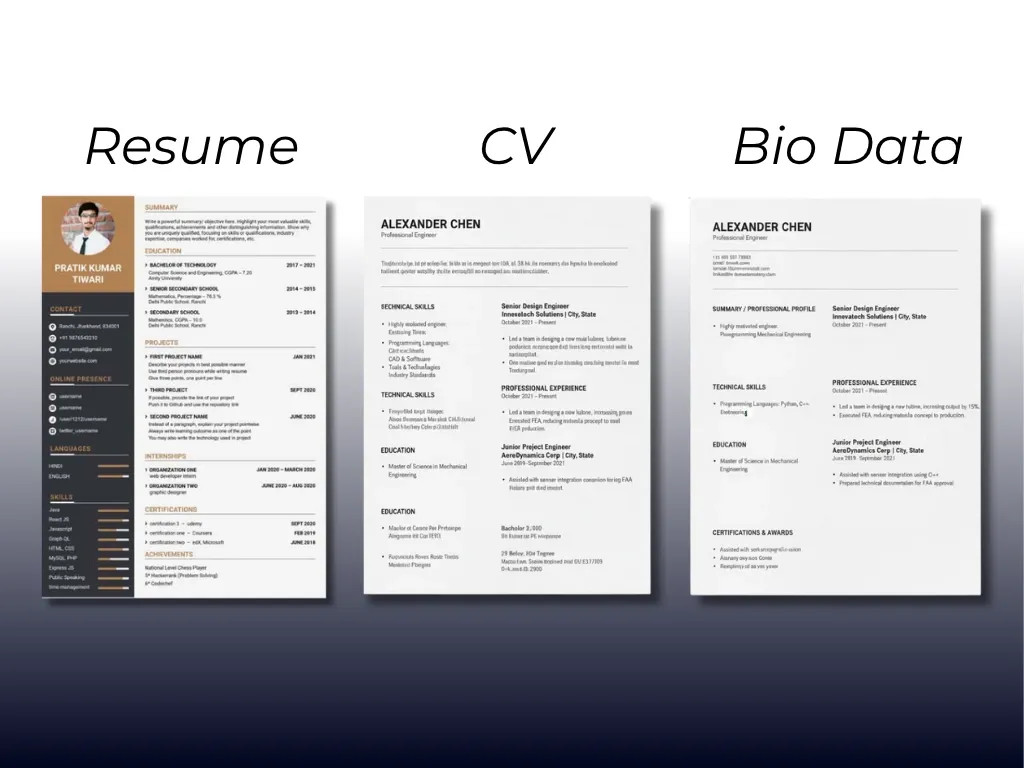
To make the differences crystal clear, here is a direct comparison
| Feature | Resume | CV (Curriculum Vitae) | Biodata |
|---|---|---|---|
| Meaning | Summary | Course of Life | Biographical Data |
| Length | Concise (1-2 pages) | Comprehensive (2+ pages) | Concise (1-2 pages) |
| Focus | Skills & Achievements | Academic & Career History | Personal Demographics |
| Customisation | High - Tailored per job | Low - Static & Comprehensive | Very Low - Factual |
| Preferred Use | Corporate Jobs (US/Canada) | Academia, Research, Medicine, Europe | Government Jobs (South Asia), Matrimonial |
| Key Content | Work Experience, Skills, Education | Publications, Research, Teaching, Awards | DOB, Marital Status, Religion, Address |
| Format | Flexible, achievement-oriented | Rigid, chronological | Simple, fact-based listing |
10 Key Differences Between CV and Resume
Now, let's get to the heart of the matter. Understanding the difference between CV and resume is crucial for your job search success. While they share the goal of landing you an interview, their approach is fundamentally different. Here are 10 key distinctions that set them apart.
1. Length: Comprehensive vs. Concise
- CV: No set limit. It is a comprehensive document that grows throughout your career, often stretching to 3, 5, 10, or even 15 pages for a seasoned academic.
- Resume: Strictly concise. Ideally one page, and absolutely no more than two pages, regardless of your experience level. Brevity and impact are valued above completeness.
2. Core Focus: Academic Pedigree vs. Professional Skills
- CV: Focuses on your academic and research pedigree. It highlights your scholarly contributions, teaching philosophy, and intellectual journey.
- Resume: Focuses on your marketable skills and professional achievements. It answers the question, "What can you do for my company?"
3. Primary Purpose: To Chronicle vs. To Market
- CV: Its purpose is to chronicle your entire professional and academic life, providing a complete historical record.
- Resume: Its purpose is to market you for a specific role. It's a persuasive document designed to sell your most relevant skills.
4. Customization: Static vs. Dynamic
- CV: Largely static. You add new achievements (a publication, a conference talk) but rarely remove old ones or significantly change the structure for different applications.
- Resume: Highly dynamic and tailored. You should actively customize it for every single job application, highlighting the experiences that make you a perfect fit for that specific role.
5. Geographic Usage: Global Academia vs. American Corporate
- CV: The standard document for job applications in the UK, EU, Africa, New Zealand, and is the universal language of academia, medicine, and research worldwide.
- Resume: The standard document in the United States and Canada for virtually all roles in the private corporate sector.
6. Key Sections: Publications vs. Professional Summary
- CV: Defined by sections like Publications, Research Experience, Conference Presentations, Grants, and Teaching Philosophy.
- Resume: Defined by sections like a Professional Summary, Core Competencies/Skills, and Work Experience focused on quantifiable results.
7. Tone: Formal and Scholarly vs. Action-Oriented
- CV: The tone is formal, scholarly, and factual. It lists accomplishments and credentials in a straightforward manner.
- Resume: The tone is action-oriented and persuasive. It uses powerful action verbs (e.g., "orchestrated," "accelerated," "pioneered") and focuses on outcomes.
8. Order of Sections: Education-First vs. Experience-First
- CV: Typically leads with the Education section, especially for early-career academics, followed by research and publications.
- Resume: Typically leads with the Work Experience section, showing your most recent and relevant roles first, with education following.
9. Design & ATS: Minimalist vs. Strategic
- CV: Traditionally minimalist in design. The focus is entirely on the content, with little to no graphic design elements. ATS compatibility is less of a primary concern.
- Resume: Strategic and clean design. While still professional, more thought is put into layout for readability. It must be optimized for Applicant Tracking Systems (ATS), avoiding columns and graphics that can confuse the software.
10. Audience: Search Committees vs. HR Recruiters
- CV: Written for a specialized audience like a university search committee, a research panel, or a fellow expert in your field who will read it in detail.
- Resume: Written for a busy HR recruiter or hiring manager who may only spend 7-10 seconds on an initial scan, requiring key information to be immediately obvious.
Real Examples – CV vs Resume vs Biodata
Let's make this tangible. Imagine a professional named "Rohan Mehta" applying for different opportunities.
CV Example Outline
- Use Case: Applying for a "Professor of Computer Science" role at a university.
- Content: A 5-page document detailing his PhD, Postdoctoral research, list of 12+ publications, conferences he's spoken at, research grants won, and teaching philosophy.
Resume Example Outline
- Use Case: Applying for a "Senior Software Engineer" role at a tech startup.
- Content: A crisp 2-page document with a powerful summary, a "Technical Skills" section, and work experience bullet points like: "Led a team that reduced API latency by 30%, improving user satisfaction scores."
Biodata Example Outline
- Use Case: Filling out an application for a government engineering position or a matrimonial profile.
- Content: A 1-page document with fields for Name, Father's Name, Date of Birth, Educational Qualifications (Degree, University, Percentage), and Languages Known.
How to Choose the Right Document
Feeling overwhelmed? Use this simple decision tree to choose the right document every time.
- Where is the job?
- USA/Canada Corporate Job? -> Use a Resume.
- UK/Europe/Academia Anywhere? -> Use a CV.
- Indian Government Job or Matrimonial Site? -> Use Biodata.
- What is the industry?
- Corporate/Private Sector (IT, Finance, Marketing)? -> Resume.
- Academia, Research, or Medicine? -> CV.
- Filling out an official form? -> Biodata.
Tips to Write an Impressive CV or Resume in 2026
Whichever document you create, these modern tips will ensure it gets noticed for the right reasons.
ATS-Friendly Formatting
Most large companies use Applicant Tracking Systems (ATS)—software that scans your document before a human sees it.
- Use a clean, single-column layout.
- Stick to standard fonts like Arial or Calibri.
- Avoid images, graphics, and tables in the main body.
- Use keywords from the job description naturally throughout your text.
Keep it Concise and Impactful
- Use action verbs (e.g., "Spearheaded," "Optimized," "Developed").
- Quantify your achievements! Instead of "Managed social media," write "Grew social media engagement by 45% over 6 months."
Tailor for Each Application
This is the golden rule, especially for resumes. A generic application is a weak application. Spend 15 minutes customizing your summary and experience points to mirror the language and requirements of the specific job you want.
Key Takeaways / Conclusion
Let's recap the core difference between CV and resume and where Biodata fits in:
- A Resume is your sharp, one-page marketing pitch for the corporate world. It's tailored and concise.
- A CV is your detailed, academic life story for research, medicine, and academia. It's comprehensive and grows with you.
- Biodata is your factual, no-frills profile for specific official or matrimonial uses, especially in India.
Using the correct document isn't just about following a rule, it's about speaking the same language as your potential employer. It shows professionalism, attention to detail, and cultural awareness. Now that you're armed with this knowledge, you can step into your job search with confidence.
Avoid these common resume mistakes that most freshers make.
FAQs – CV vs Resume vs Biodata
- What is the difference between a CV and a resume?
The core difference between a CV and a resume is length, content, and purpose. A CV is a detailed, static record of your entire academic career (no page limit), while a resume is a concise, tailored summary of your relevant skills and experiences (1-2 pages) for a specific corporate job.
- What is biodata and how is it different?
Biodata is a factual profile focusing on personal and educational details, often presented in a simple format. The key difference between CV and resume and biodata is that biodata is not a marketing document. It's used for official records, certain government applications, and matrimonial purposes, primarily in South Asia.
- Which one should I use for job applications in India?
It depends on the employer:
- For private sector/MNCs, use a Resume.
- For academic or research institutes, use a CV.
- For government jobs (Sarkari Naukri) or when an application form requests it, use a Biodata format. Always check the job posting for instructions.
- Is a CV the same as a resume abroad?
No. In the UK, Ireland, New Zealand, and Europe, "CV" refers to the document you'd use for any job application (which is typically closer to what the US calls a resume, but can be longer). In the US and Canada, a CV is strictly for academic/medical/research roles, and a "resume" is used for everything else.
- Can a resume be more than 2 pages?
As a general rule for 2026, no. Recruiters expect brevity. A one-page resume is ideal for most professionals with under 10 years of experience. A two-page resume is acceptable for those with extensive, highly relevant experience. Going beyond two pages for a standard corporate role risks your application being ignored.
Ready to build your professional Resume or CV? Create it effortlessly using Hiretip’s Resume Builder today and stand out in 2025!