You’re on a job hunt, polishing your application documents, and suddenly you’re faced with a dilemma. The company asks for a "CV," but all you’ve ever had is a "resume." Your friend mentions "Biodata," and it sounds like something entirely different. Are these just different names for the same thing, or is there a crucial distinction?
The short answer: They are not the same.
Using the wrong document can signal a lack of awareness to a potential employer. At HireTip, we believe the right tool for the right job is the first step to landing an interview.
In this definitive guide, we’ll demystify these three terms, Biodata, Resume, and CV, with a clear side-by-side comparison. By the end, you’ll know exactly when to use what, ensuring your application always makes the perfect first impression.
The 30-Second Overview
Before we dive deep, here’s the quick breakdown:
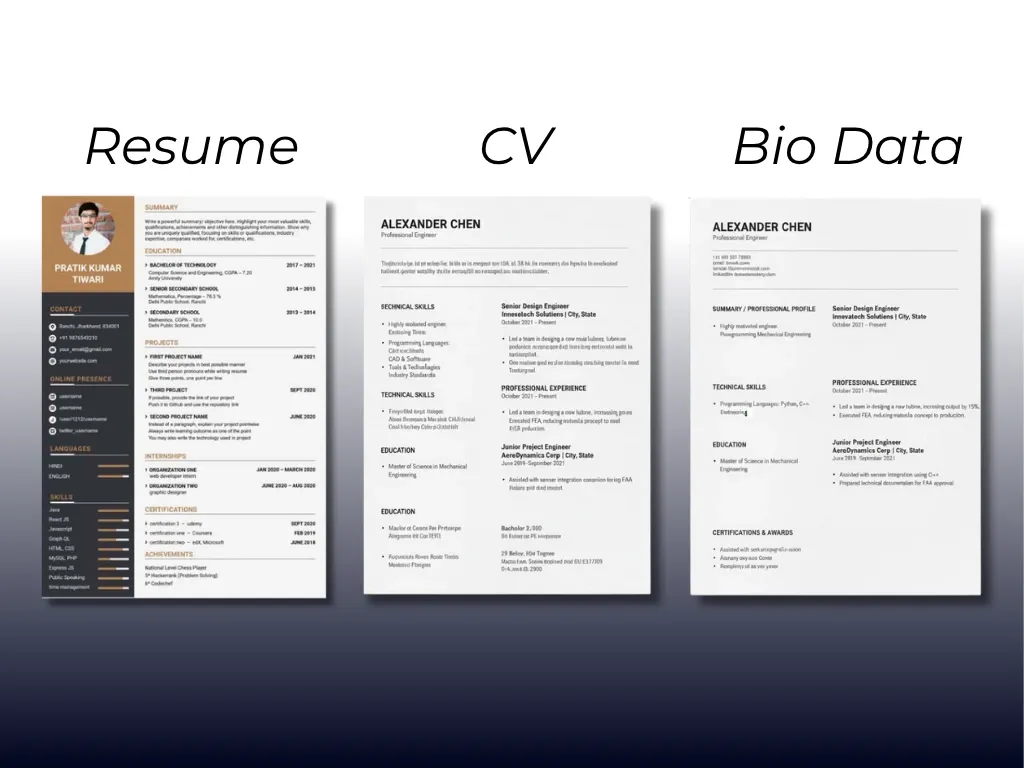
- Resume: A targeted, concise summary of your skills, work experience, and achievements for a specific job. (Common in the US & Canada for corporate jobs)
- CV (Curriculum Vitae): A comprehensive record of your entire academic and professional history. (Common in Academia, Medicine, and Europe)
- Bio A factual summary of your personal details, like date of birth, marital status, and religion. (Common in South Asia for government jobs or matrimonial profiles)
Now, let's explore each one in detail.
1. The Resume: Your Targeted Career Snapshot
Resume Meaning: A French word meaning "summary," a resume is exactly that, a brief, one-to-two-page document that markets your most relevant skills and experiences for a specific role.
Key Characteristics:
- Length: Typically, 1 page, max 2 pages for experienced professionals.
- Focus: Relevance. It highlights what makes you the perfect fit for this specific job.
- Customization: It should be tailored for every single job application, using keywords from the job description.
- Format: Reverse-chronological (most recent job first) is most common, but functional and combination formats are also used.
- Content: A sharp career objective or summary, work experience with quantifiable achievements, education, and key skills.
When to Use a Resume:
Use a resume for almost all corporate, private-sector jobs in countries like the United States and Canada. It’s the standard for industries like Tech, Marketing, Sales, and Finance.
Pro-Tip from HireTip: Recruiters spend an average of 7 seconds on a resume. Make yours skimmable, use bullet points, and focus on achievements (e.g., "Increased sales by 20%") over responsibilities (e.g., "Responsible for sales").
2. The CV (Curriculum Vitae): Your Comprehensive Academic Chronicle
CV Meaning: Curriculum Vitae is Latin for "course of life." A CV is a detailedand in-depth document that presents a comprehensive history of your academic credentials, teaching experience, and research background.
Key Characteristics:
- Length: Can be 2, 3, or even 10+ pages, as it expands throughout your career.
- Focus: Comprehensiveness. It leaves no academic stone unturned.
- Customization: Less about tailoring for a specific job and more about keeping it meticulously updated with every new accomplishment.
- Format: Strictly chronological, providing a linear account of your career.
- Content: Includes publications, research projects, grants, fellowships, teaching experience, presentations, awards, and affiliations, in addition to work history and education.
When to Use a CV:
Use a CV when applying for:
- Academic positions (e.g., professor, researcher)
- Research roles (in sciences or humanities)
- Fellowships or grants
- Medical and scientific positions
- Jobs in most European, Middle Eastern, African, and Asian countries (where "CV" is synonymous with what Americans call a "resume").
3. The Bio Your Factual Personal Profile
Biodata Meaning: Short for "Biographical Data," this is the most straightforward of the three. It is a simple document that lists your personal and factual information.
Key Characteristics:
- Length: Usually 1-2 pages.
- Focus: Personal demographics and facts.
- Customization: Minimal; the content remains largely the same.
- Format: Often in a simple paragraph or list format.
- Content: Focuses on details like Date of Birth, Gender, Marital Status, Nationality, Religion, Parents' Names, Permanent Address, and sometimes a declaration.
When to Use Bio
Biodata is primarily used in:
- Government jobs in India and other South Asian countries where such personal details are required for official records.
- Matrimonial profiles, where families exchange information for potential matches.
- Certain internal company forms require employee background information.
Important Note: In most Western countries, including information like your photo, marital status, or religion on a resume or CV is strongly discouraged and can lead to discrimination claims.
Side-by-Side Comparison: Biodata vs Resume vs CV
To make the differences crystal clear, here is a direct comparison:
| Feature | Resume | CV (Curriculum Vitae) | Biodata |
|---|---|---|---|
| Meaning | Summary | Course of Life | Biographical Data |
| Length | Concise (1-2 pages) | Comprehensive (2+ pages) | Concise (1-2 pages) |
| Focus | Skills & Achievements | Academic & Career History | Personal Demographics |
| Customisation | High - Tailored per job | Low - Static & Comprehensive | Very Low - Factual |
| Preferred Use | Corporate Jobs (US/Canada) | Academia, Research, Medicine, Europe | Government Jobs (South Asia), Matrimonial |
| Key Content | Work Experience, Skills, Education | Publications, Research, Teaching, Awards | DOB, Marital Status, Religion, Address |
| Format | Flexible, achievement-oriented | Rigid, chronological | Simple, fact-based listing |
When to Use What? Your Quick-Decision Guide
Still unsure? Use this simple flowchart:
- Where is the job located?
- USA or Canada for a corporate job? → Use a Resume.
- Europe, the Middle East, Africa, or Asia? → They likely mean a CV (which is their term for a resume). Check the job description for clues.
- India or South Asia for a government job? → They may explicitly ask for a Biodata format for job applications.
- What is the industry?
- Academia, Research, Science, or Medicine? → Always use a comprehensive CV.
- Private Sector (Tech, Business, etc.)? → Almost always use a targeted Resume.
- What does the job description say?
- This is the ultimate decider. If they ask for a "CV," send them a CV (in the academic sense if it's a research role, or in the international sense if it's a European company). If they ask for a "resume," send a resume. Never send a Biodata for a standard corporate job in the West.
How to Convert a Resume to a CV (and Vice Versa)
From Resume to CV:
If you're a corporate professional applying for an academic role, you need to expand your resume into a CV.
- Add sections for Publications, Research Experience, Conference Presentations, Grants Awarded, and Teaching Mentorship.
- Elaborate on every relevant project and academic honour.
From CV to Resume:
If you're an academic transitioning to the corporate world, you need to condense your CV into a powerful resume.
- Cut it down to 2 pages maximum. Be ruthless.
- Remove less relevant publications and exhaustive conference lists.
- Re-frame your experience around skills and achievements rather than just listing duties.
- Focus on transferable skills like project management, analysis, and leadership.
Final Takeaways from HireTip
Understanding the difference between a Biodata, Resume, and CV is more than semantics; it's about professional etiquette and strategic communication.
- Resume = Marketing Document. It's your personal advertisement for a specific job.
- CV = Academic Archive. It's your complete professional life story.
- Biodata = Fact Sheet. It's a formal record of your personal information.
By using the correct document, you demonstrate to employers that you understand industry standards and pay attention to detail. You stop being just another application and start being a serious, informed candidate.
Your Next Step: Review the job description carefully. Identify the location, industry, and specific requirements. Then, choose your weapon wisely and craft a document that perfectly positions you for success.
Struggling to craft the perfect resume or CV? Explore HireTip’s expert guides and templates to build a job application that gets results.
FAQs
Q: What is the difference between a biodata, a resume, and a CV?
A biodata focuses on personal details and is mostly used for government or matrimonial purposes. A resume is a concise summary of your skills and experience for job applications. At the same time, a CV, on the other hand, provides a detailed overview of your academic and professional achievements.
Q: When should I use a biodata instead of a resume?
Use a biodata when applying for government, public sector jobs, or when an organization specifically requests it. For most private sector roles, a resume is preferred.
Q: How long should a CV or resume be?
A resume should typically be 1–2 pages, highlighting relevant experience. A CV can be longer, especially for academic, research, or international positions, as it includes detailed information on publications, certifications, and educational history.
Q: Can I convert my resume into a CV easily?
Yes, you can expand your resume by adding detailed sections such as academic achievements, projects, research, publications, and professional certifications to create a CV.
Q: Are biodata, resume, and CV formats standard everywhere?
No, formats vary by country, industry, and organization. Always follow the specific guidelines provided in the job posting or institution requirements.