
You’ve spent hours polishing your resume. The formatting is flawless, every bullet point is a testament to your skills, and you’re confident that it’s your golden ticket to an interview. You hit ‘submit’ and wait. But what happens next?
Your application doesn’t land directly on a recruiter’s desk. In today’s digital hiring world, it first has to pass through a gatekeeper: an Applicant Tracking System (ATS). This software is the reason why, sometimes, even when you’re a perfect fit, you hear nothing but silence.
The key to unlocking this digital gate? Understanding your ATS score.
At HireTip, our mission is to demystify the job search. In this comprehensive guide, we’ll explain what an ATS score really means, what an ideal score looks like, and give you an actionable blueprint to improve yours. Think of this as your insider’s manual to getting your resume seen by human eyes.
What is an Applicant Tracking System (ATS) Anyway?
Before we dive into the score, let's understand the system. An ATS is software used by over 95% of medium to large-sized companies to manage the flood of applications they receive for every job opening. It’s essentially a digital filing cabinet that helps recruiters:
- Store and organise candidate information.
- Track the application process from submission to hire.
- Filter applications to find the most relevant candidates quickly.
The filtering part is where your ATS score comes into play. The system isn't a sentient being judging your life choices; it’s a tool programmed to scan your resume for specific keywords, skills, qualifications, and experience that match the job description. The more matches it finds, the higher your resume scores, and the more likely it is to be shortlisted for a human review.
So, What Exactly is an ATS Score?
Your ATS score is a numerical rating (often a percentage) assigned to your resume by the ATS software. This score indicates how well your resume aligns with the specific job you applied for.
It’s not a measure of your overall worth as a professional. It’s a measure of relevance for a specific role.
How is the ATS Score Calculated?
Different ATS platforms (like Taleo, Workday, Greenhouse, Lever) have their own secret algorithms, but the general principles are consistent. The system parses your resume—converting it into plain text—and compares its content against the job description. It looks for:
- Keywords: The most critical factor. These are the specific skills, technologies, software, and qualifications mentioned in the job description (e.g., "project management," "Python," "SEO analysis," "CPA certification").
- Context and Frequency: It’s not just about listing keywords. The ATS looks for context. For example, mentioning "budget management" alongside a quantifiable result ("managed a $500k budget") is stronger than just listing it in a skills section. Moderate frequency is good; keyword stuffing is penalised.
- Titles and Experience: Does your job title history match or relate to the one in the description? Does your experience meet the "5+ years" requirement? The ATS checks for chronological consistency and duration.
- Education and Certifications: Does the role require a specific degree or credential? The ATS will flag resumes that have it.
- Formatting and Structure: A poorly formatted resume can be unreadable by the ATS, leading to a low score or even a complete parsing error.
Think of it like a search engine. When you Google "best chocolate cake recipe," the search engine scans the web for pages that are most relevant to those terms. The ATS is doing the same with your resume and the job description. A high ATS score means your resume is a top search result for that particular "query."
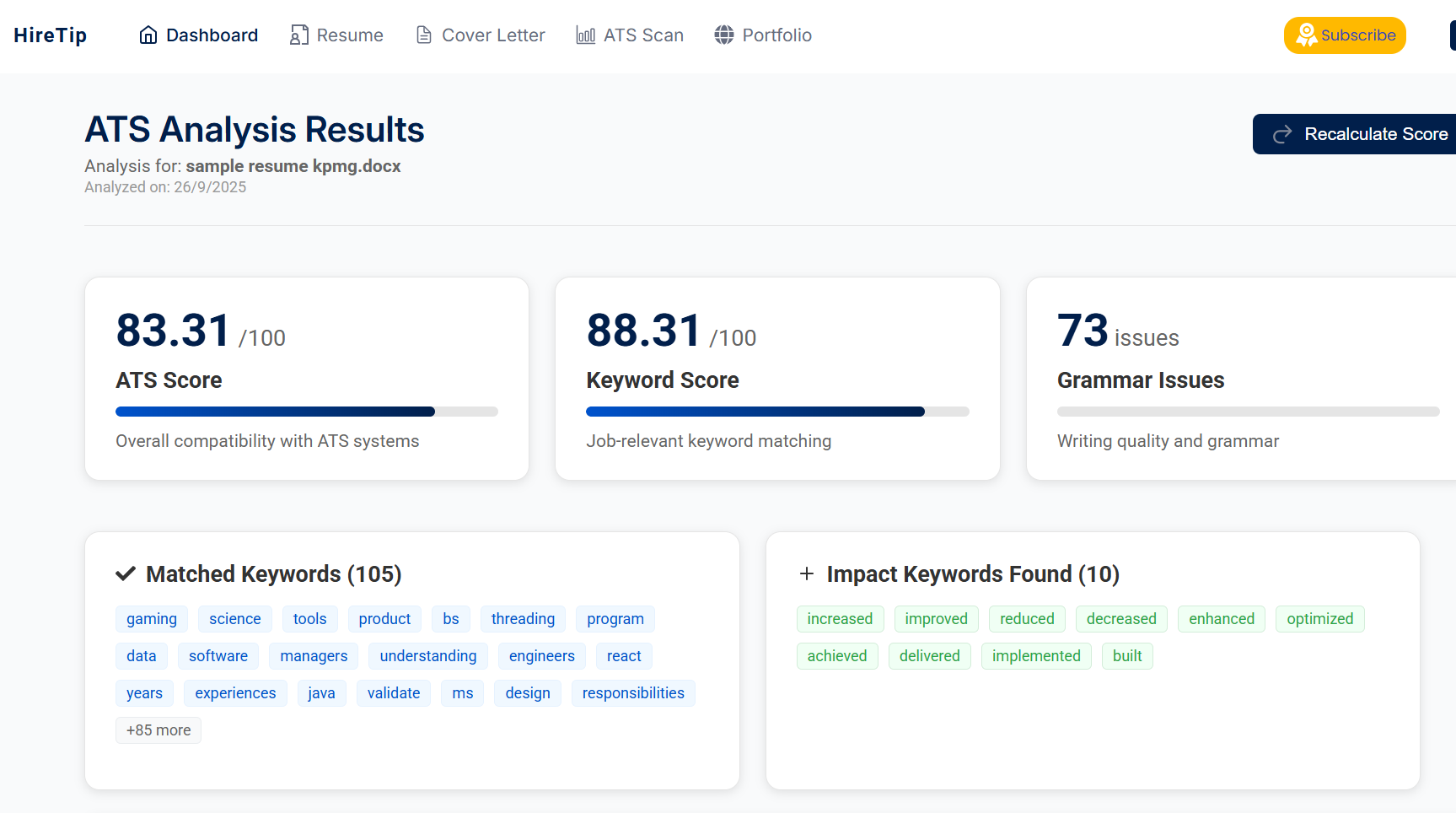
What is the "Ideal" ATS Score?
This is the million-dollar question. Unfortunately, there’s no universal magic number. Why? Because every ATS is different, and every recruiter can configure the system with their own thresholds.
However, based on industry insights, we can outline a general framework:
- Low Score (Below 40%): This indicates a poor match. The ATS has found few relevant keywords or experiences. Your resume likely won’t make it to a human recruiter unless the applicant pool is very small.
- Moderate Score (40% - 70%): This is a common range. It means there’s some relevance, but perhaps key skills are missing, or the experience level isn't quite right. Your resume might be reviewed if the candidate pool is thin, but it’s not a top contender.
- Good/High Score (70% - 85%): This is the sweet spot. It signals a strong match. Your resume has most of the required keywords and experiences. It will almost certainly be flagged for a human to review. This is your primary target.
- Very High Score (85%+): This indicates an almost perfect keyword and experience match. Be cautious, however. A score this high can sometimes be a red flag for keyword stuffing, which both the ATS and human recruiters can detect. Authenticity is key.
The real goal is not to hit a specific number but to consistently land in the "Good/High" range. This proves to the system, and eventually, the recruiter, that you are a highly relevant candidate for the position.
How Can I Check My Resume's ATS Score?
You can’t see the exact score your resume receives when you apply to a company, as that happens within their private ATS. However, you can get a very accurate estimate by using an ATS score checker or a resume score checker.
These are online tools designed to mimic the parsing and scoring function of a real ATS. At HireTip, we believe in the power of preparation. Using a reliable ATS score checker before you apply is like a dress rehearsal for your resume. It allows you to:
- Identify missing keywords from a specific job description.
- Spot formatting errors that could cause parsing mistakes.
- Get an objective, data-driven assessment of your resume’s strength.
When you use an ATS score checker, always paste the full job description you’re targeting into the tool. This gives you the most accurate and actionable feedback possible.
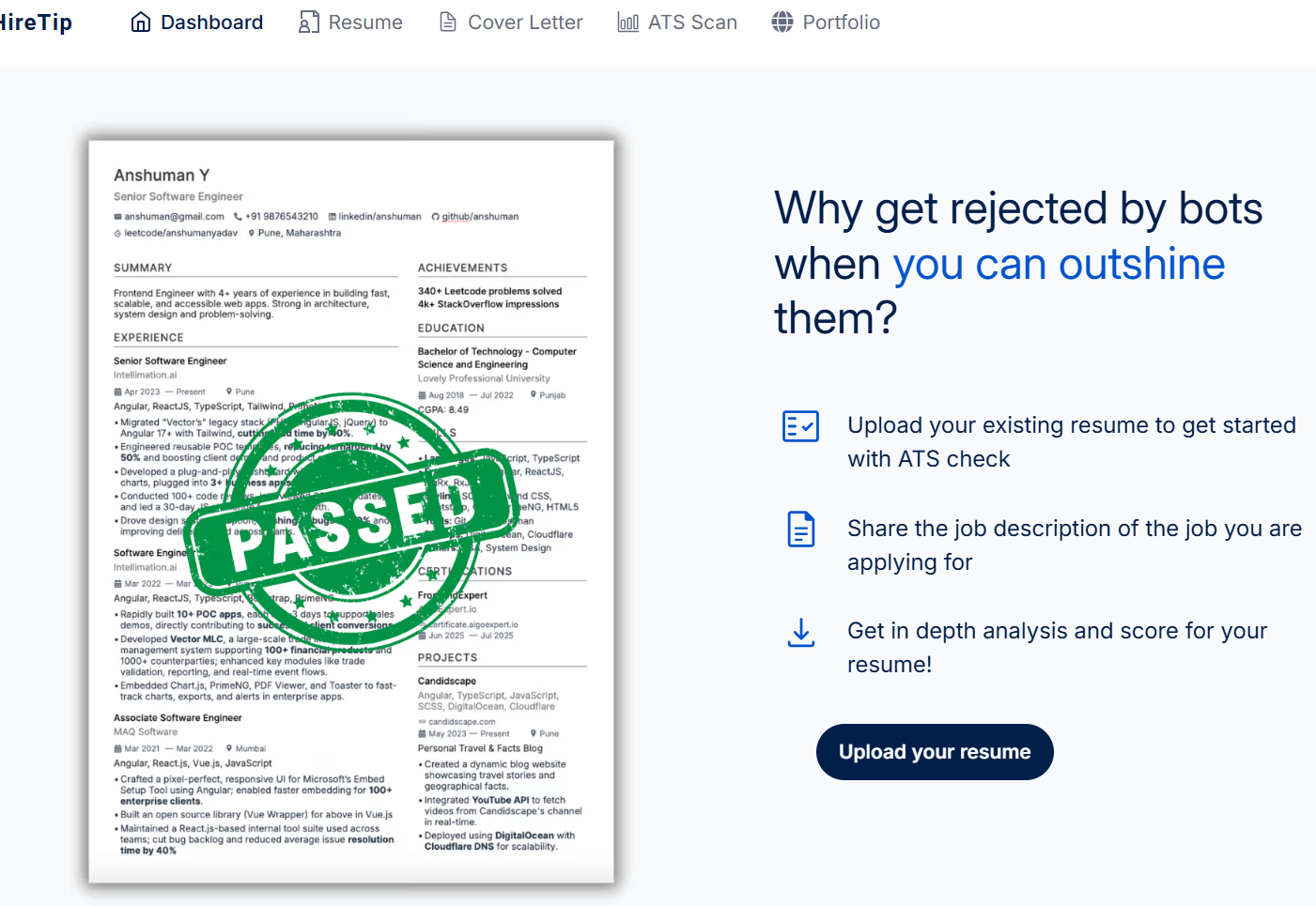
The Ultimate Guide: How to Improve Your ATS Score
Now for the practical part. Improving your ATS score is a systematic process. Follow these steps to transform your resume from ATS-invisible to ATS-optimised.
Step 1: Master the Art of Keyword Research
Your first task is to treat the job description as your blueprint. Don’t just read it; analyse it.
- Identify "Must-Have" Keywords: Highlight all the nouns and noun phrases related to skills, software, tools, and certifications. These are your primary keywords.
- Example: For a Digital Marketing Manager role, keywords might be: "Google Analytics," "SEO/SEM," "email marketing automation," "CRM," "content strategy," "ROI analysis."
- Identify "Nice-to-Have" Keywords: Look for action verbs and descriptive phrases that hint at desired qualities: "data-driven," "cross-functional collaboration," "lead generation," "strategic planning."
- Look for Synonyms and Variations: If the description says "client acquisition," also consider using "customer acquisition" or "lead generation." Don't just repeat the same phrase verbatim.
Step 2: Integrate Keywords Strategically (and Naturally)
Once you have your list of keywords, weave them throughout your resume. The goal is relevance, not repetition.
- Professional Summary: This is prime real estate. Incorporate 3-4 of the most critical keywords here.
- Work Experience: This is the most important section. Don’t just list duties; describe accomplishments using the keywords.
- Weak: Responsible for social media.
- Strong (ATS-Optimised): *Developed and executed data-driven social media strategy across 3 platforms (Facebook, Instagram, LinkedIn), increasing audience engagement by 45% in 6 months.*
- Skills Section: Have a dedicated, cleanly formatted skills section to list your technical and hard skills. This acts as a keyword hub for the ATS.
- Avoid Keyword Stuffing: This is crucial. Stuffing your resume with keywords in a way that sounds unnatural will hurt your score and look spammy to a human reader. The context is key.
Step 3: Optimize Your Resume Formatting for ATS Parsing
A beautiful, visually complex resume can be a nightmare for an ATS. Keep it simple and clean.
- Use Standard Headings: Stick to common section titles like "Work Experience," "Professional Experience," "Education," "Skills," "Certifications." Avoid creative titles like "My Journey" or "Where I've Been."
- Choose a Simple Font: Use standard, easy-to-read fonts like Arial, Calibri, Georgia, or Times New Roman.
- Avoid Graphics, Tables, and Columns: While they look nice, ATS software often cannot read text inside images, tables, or columns. This information will be lost.
- Use Standard Bullet Points: Stick to simple round or square bullets. Avoid special characters.
- Save Your File Correctly: When saving your resume, use a standard file format. A .docx file is generally safe, but a .pdf can be acceptable if it was created from a Word processor and not from a graphic design tool like Canva. However, some older ATS systems still prefer .docx. When in doubt, check the application instructions.
- Include Your Name and Contact Info in the Body Text: If your header is an image, the ATS might not read it. Ensure your name, phone number, and email are in the main body of the document.
Step 4: Quantify Your Achievements
Numbers are a universal language for both ATS algorithms and human recruiters. They provide concrete evidence of your impact.
- Instead of: "Improved sales efficiency."
- Use: "Implemented a new CRM software (Salesforce), resulting in a 20% increase in sales team efficiency and a 15% reduction in lead response time."
Quantifiable results often contain keywords ("CRM software," "Salesforce") and demonstrate value, making your resume far more powerful.
Step 5: Tailor, Tailor, Tailor!
There is no such thing as a one-size-fits-all resume. The most effective way to achieve a high ATS score is to tailor your resume for every single job you apply for.
This doesn’t mean rewriting it from scratch each time. It means:
- Analysing the new job description.
- Identifying the new keywords.
- Tweaking your professional summary and bullet points to reflect the specific language and priorities of that role.
This 15-20 minute investment per application dramatically increases your chances of success.
Beyond the Score: The Human Recruiter
Remember, a high ATS score is just the first hurdle. Its sole purpose is to get your resume onto the desk of a human recruiter. Once there, your resume needs to tell a compelling story.
Your optimised resume should still be readable, engaging, and achievement oriented. It should clearly communicate your unique value proposition. The work you did to improve your ATS score, using keywords, quantifying achievements, will also make your resume more persuasive to the person reading it.
Final Thoughts from HireTip
Navigating the world of ATS can feel daunting, but it’s a game of strategy, not chance. By understanding what an ATS score is and how to improve it, you take control of the first and most critical stage of the modern job application process.
Use the job description as your guide, incorporate keywords naturally, maintain a clean format, and always quantify your wins. And before you hit 'submit' on that dream job, take advantage of an ATS score checker to get that final confidence boost.
Your perfect resume is not just a list of your past jobs; it’s a strategic document designed to be found. At HireTip, we’re here to help you at every step. Now, go get that score up and land that interview!
Frequently Asked Questions on ATS Score
- What is an ATS score in a resume?
Ans: An ATS score shows how closely your resume matches a job description. It’s calculated by scanning your resume for relevant keywords, skills, job titles, and formatting that the Applicant Tracking System can easily read.
- What is a good ATS score for a resume?
Ans: A good ATS score is usually 70% or higher. This means your resume aligns well with the role’s requirements and has a strong chance of reaching a recruiter for manual review.
- Why does my resume get a low ATS score even with relevant skills?
Ans: This often happens when skills are written differently from the job description, placed in graphics or tables, or buried in long paragraphs. ATS tools rely on clear wording, proper sections, and exact or close keyword matches.
- Can keyword stuffing increase my ATS score?
Ans: No. Keyword stuffing can actually hurt your chances. ATS systems look for natural, relevant usage, and recruiters quickly reject resumes that feel forced or unreadable. Quality placement matters more than repetition.


